Bridging Analog and Digital Perception with Conductive Ink and Neuroscience
TL;DR
My BFA thesis at Paris College of Art investigated how the shift from print to digital reading is reshaping neural development, empathy, and deep thinking. Rather than choosing sides, I built a working hybrid book prototype that bridges both — using conductive ink circuits connected to a Raspberry Pi, coded in Python, allowing readers to touch words in a physical book and receive curated digital content on their phone. The project crossed design, neuroscience, hardware engineering, and user research — and became the intellectual foundation for my later work on dark patterns, cognitive biases, and responsible technology.
Context
We are in the middle of the most significant shift in reading technology since the printing press. Research from UCLA, Emory University, and the University of Stavanger demonstrates that the way we read — on paper versus on screen — produces measurably different neurological outcomes. Screen reading activates different neural circuits than print reading. The implications for empathy, deep comprehension, and sustained attention are real and documented.
For my senior thesis at Paris College of Art, I wanted to ask a question that was not being asked in the design world: What happens to human cognition when we abandon analog reading for digital? And is there a way to bridge the two rather than choosing one over the other?
The Research
I began with a systematic literature review spanning neuroscience, publishing history, and technology theory. The goal was not to argue that print is better than digital or vice versa — it was to understand what each modality does to the brain and whether a hybrid approach could preserve the benefits of both.
Neuroscience of reading: I synthesized research on how reading circuits develop differently depending on the medium. Print reading builds neural pathways associated with deep comprehension, sustained focus, and empathic response. Screen reading activates different patterns — faster scanning, shallower processing, reduced memory retention. Neither is inherently superior, but the shift from one to the other has measurable cognitive consequences that most technologists ignore.
A novel analytical framework: To structure the analysis, I developed a three-category framework for classifying human-book interaction modalities:
- Passive Expressive: Traditional books where the reader receives content without interactive capability
- Neutral Expressive: E-readers and tablets that digitize reading but do not fundamentally change the interaction model
- Active Expressive: Hybrid formats where physical and digital elements interact, creating a new modality that neither alone provides
This framework allowed me to identify the gap that my prototype would fill — an Active Expressive reading experience that preserves the neurological benefits of physical reading while extending it with digital capability.
User interviews: I conducted interviews with 4 participants aged 4 to 34, exploring reading habits across age groups. The interviews revealed that even in 2018, the youngest participants had already internalized digital-first reading patterns, while older participants described reading experiences that aligned with the neuroscience literature on deep comprehension.
The Prototype
The thesis required not just research but a working artifact. I designed and built a physical hybrid book that demonstrates the Active Expressive concept:
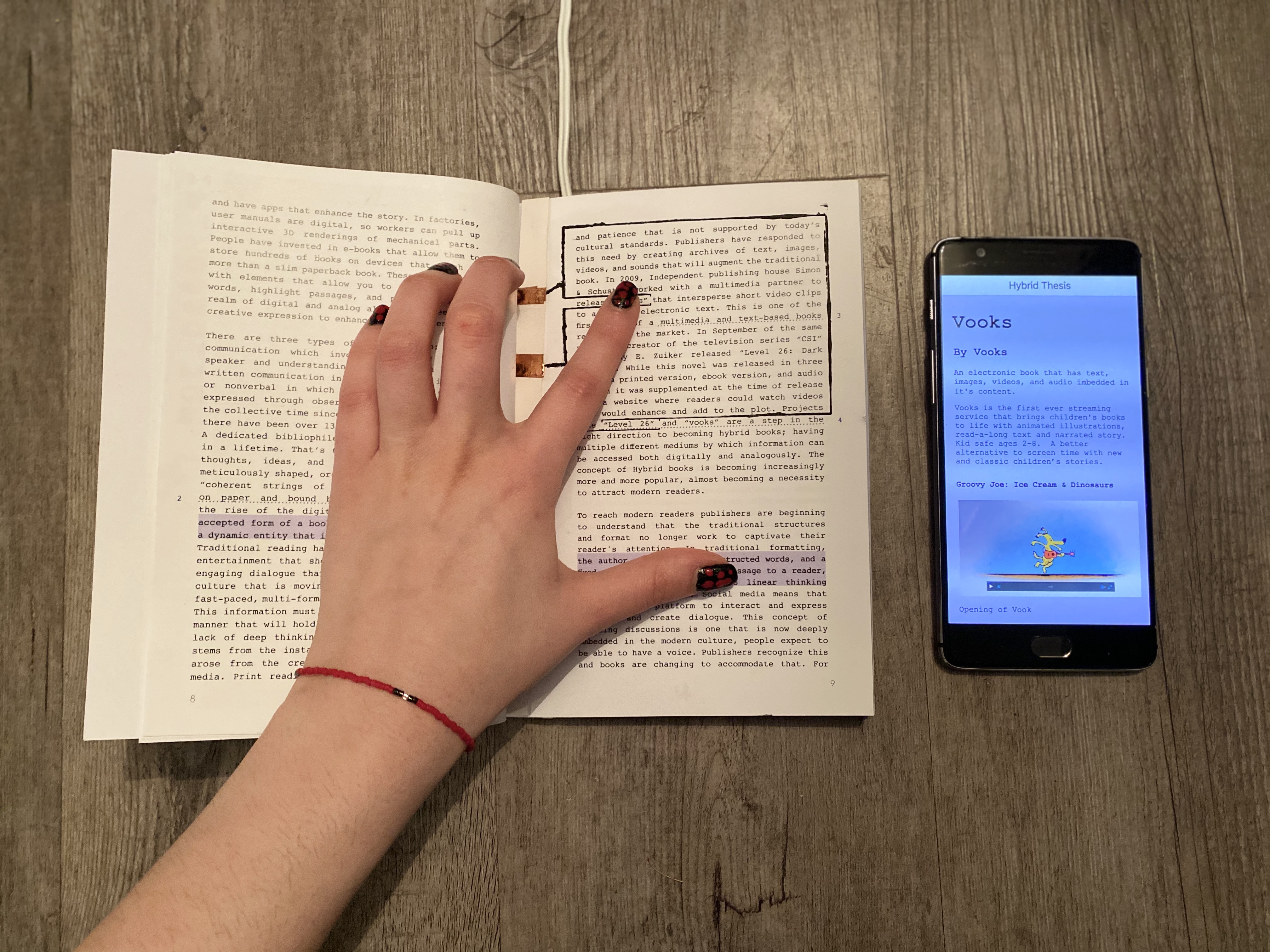
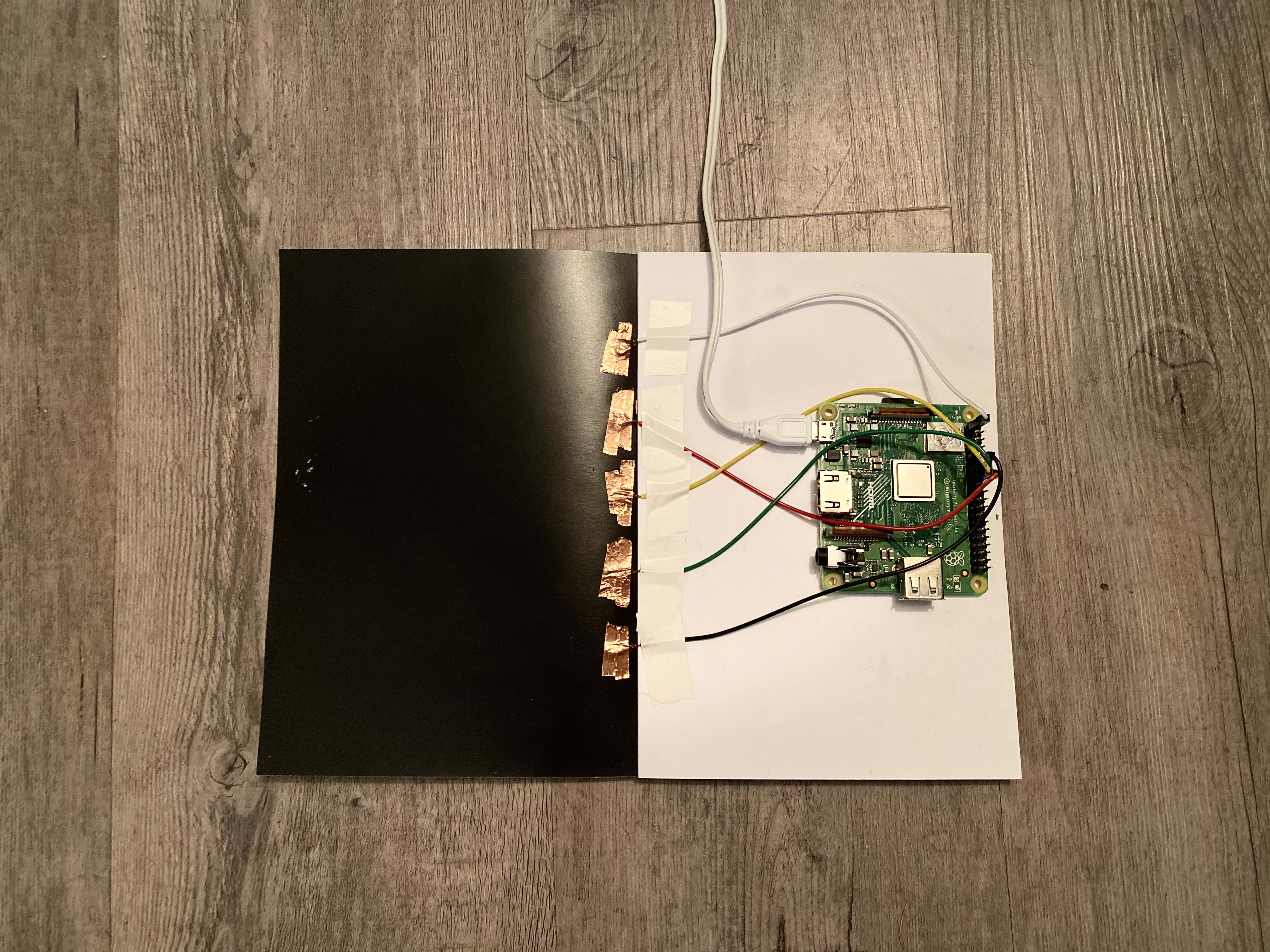
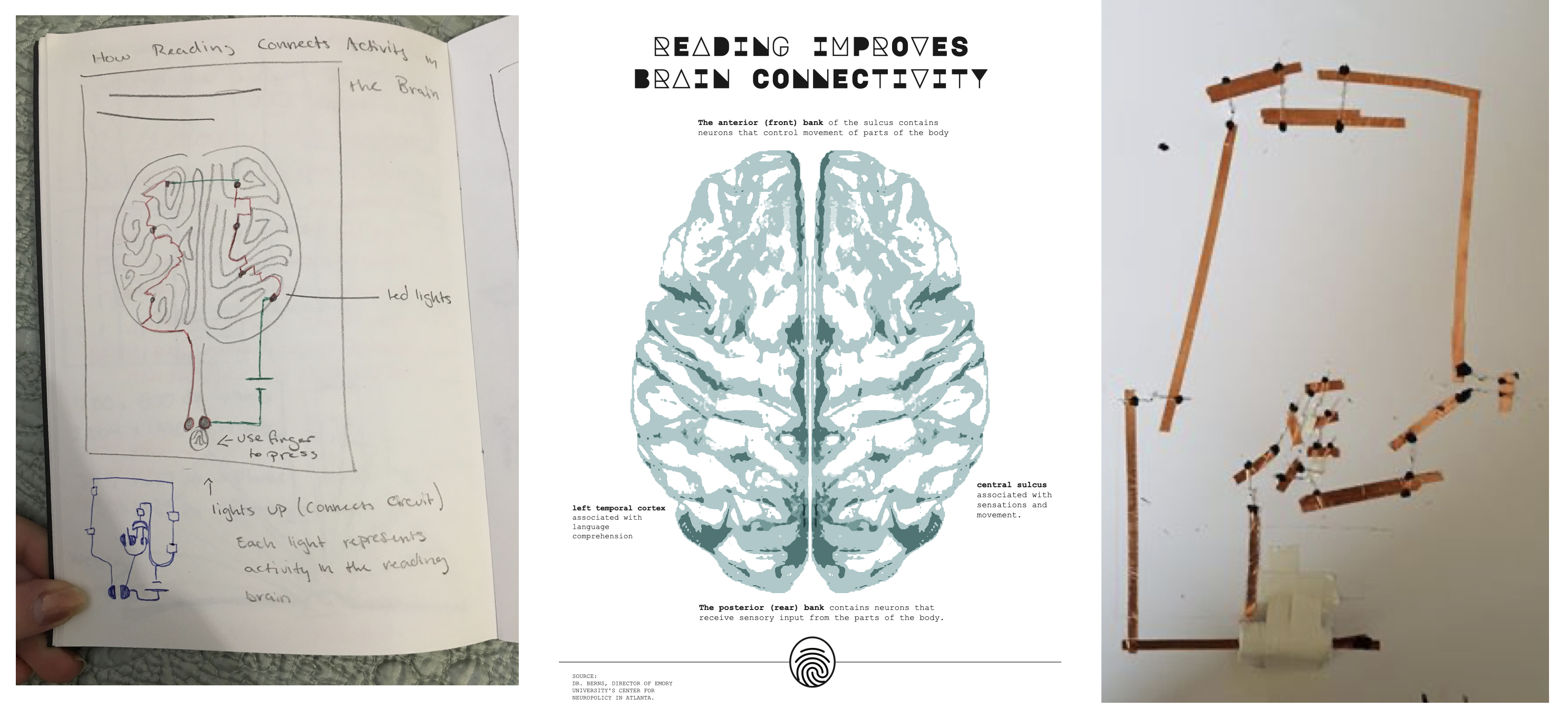
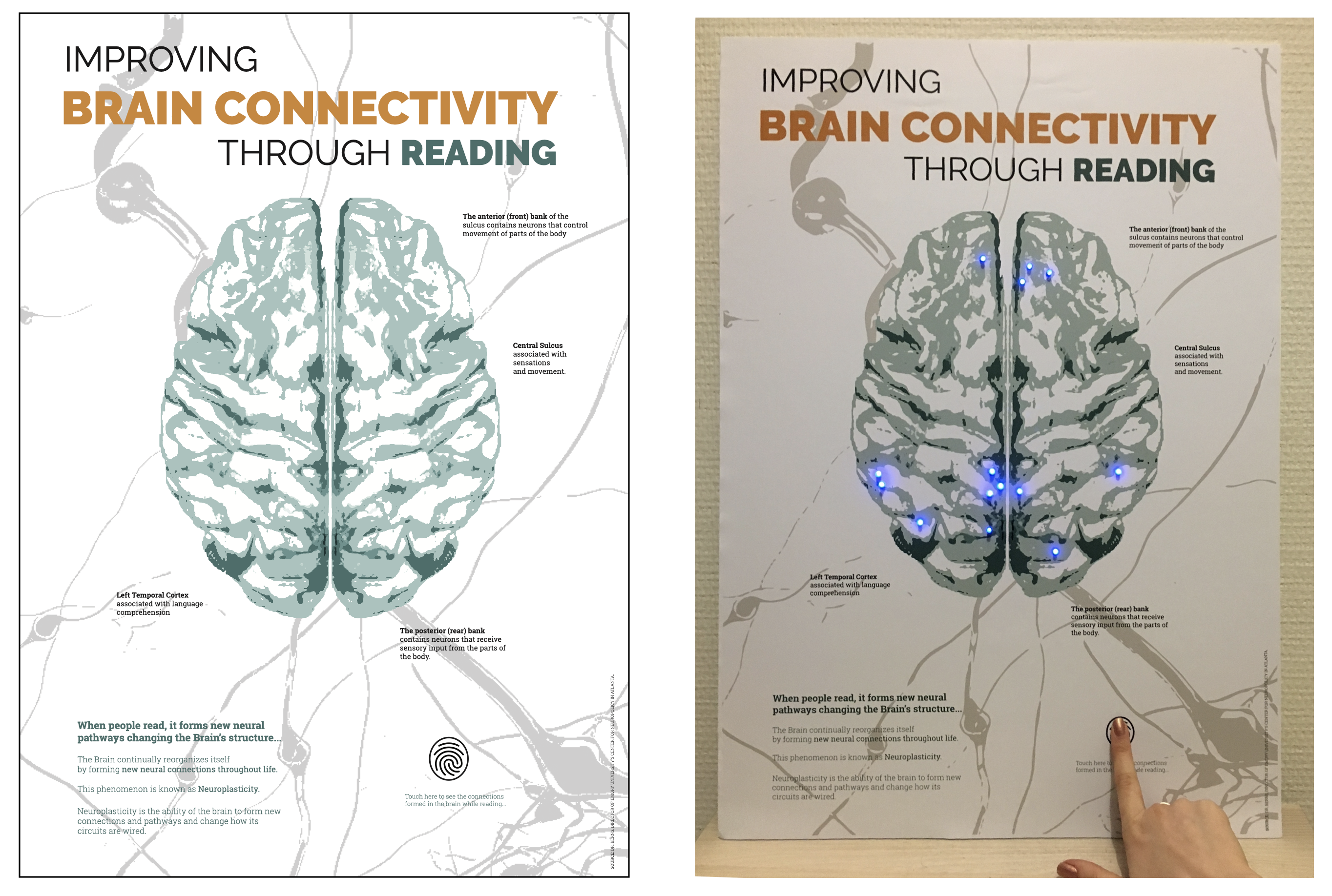
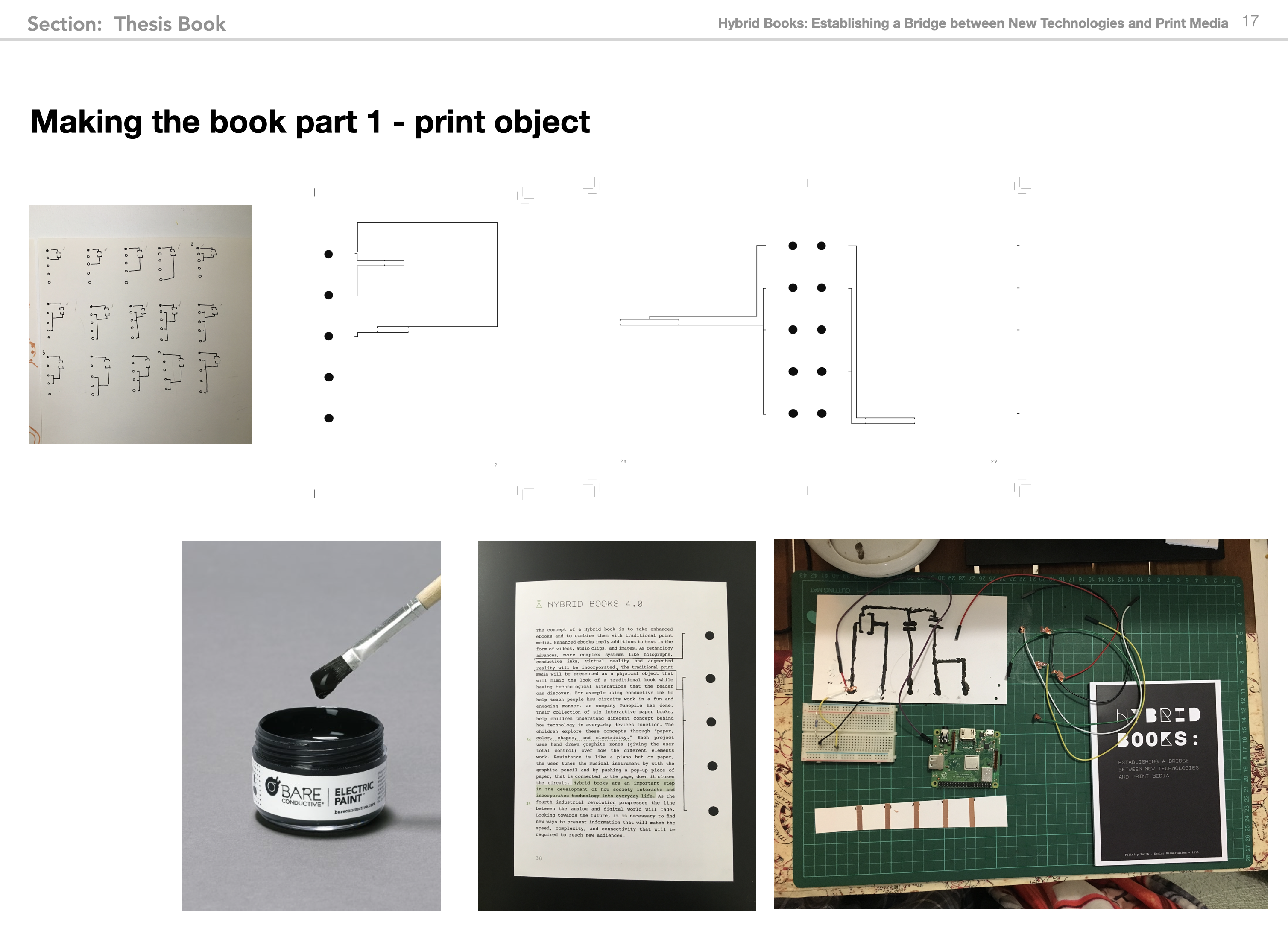
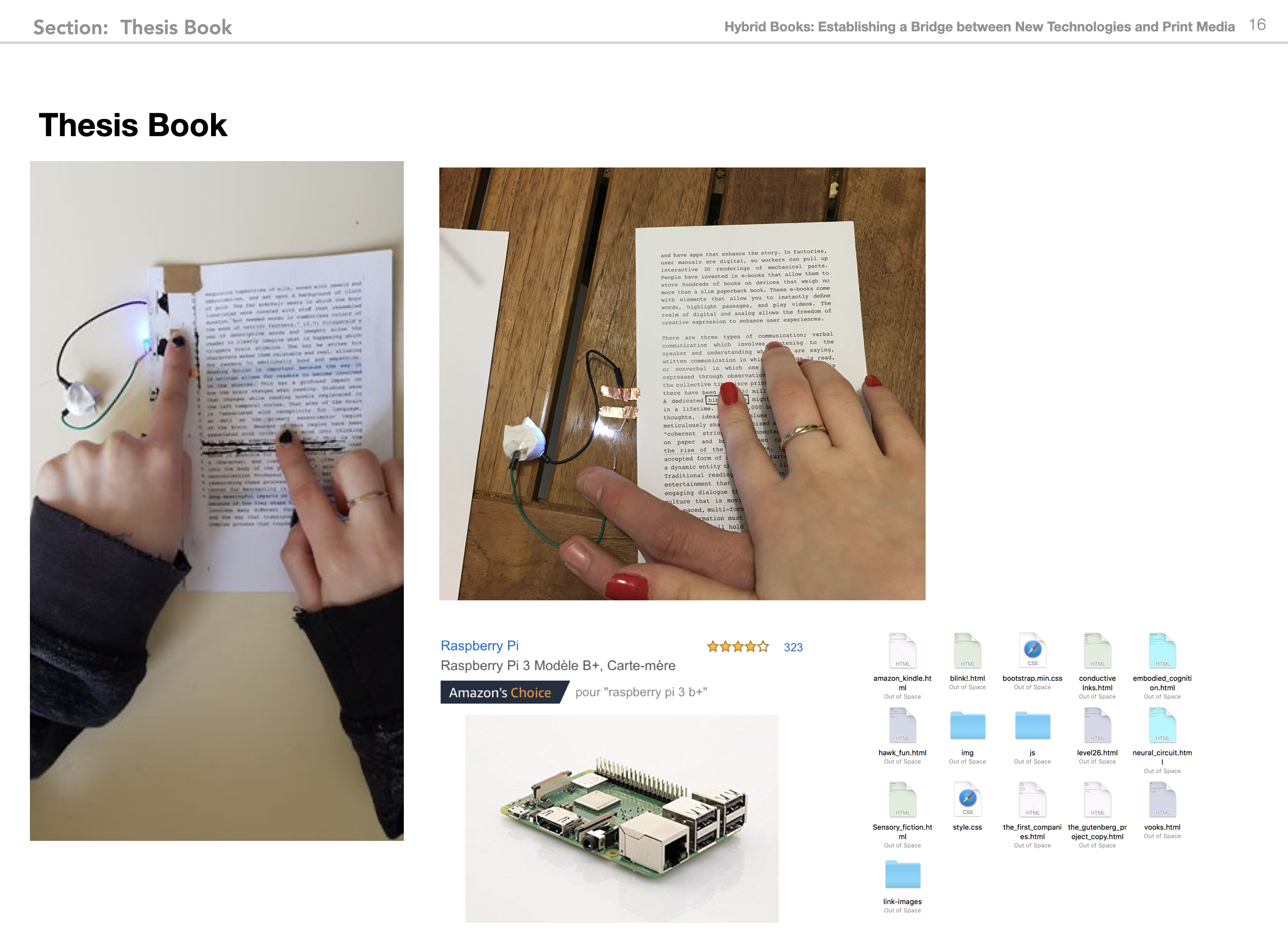
Hardware: Conductive ink circuits printed directly onto book pages, connected to a Raspberry Pi microcomputer. When a reader touches a word or phrase in the physical book, the conductive ink completes a circuit that triggers a corresponding digital response.
Software: Python code running on the Raspberry Pi maps each conductive ink touchpoint to a curated web resource — articles, videos, interactive visualizations — that extends the physical text. The mapping uses binary code ordering to manage the relationship between physical touchpoints and digital destinations.
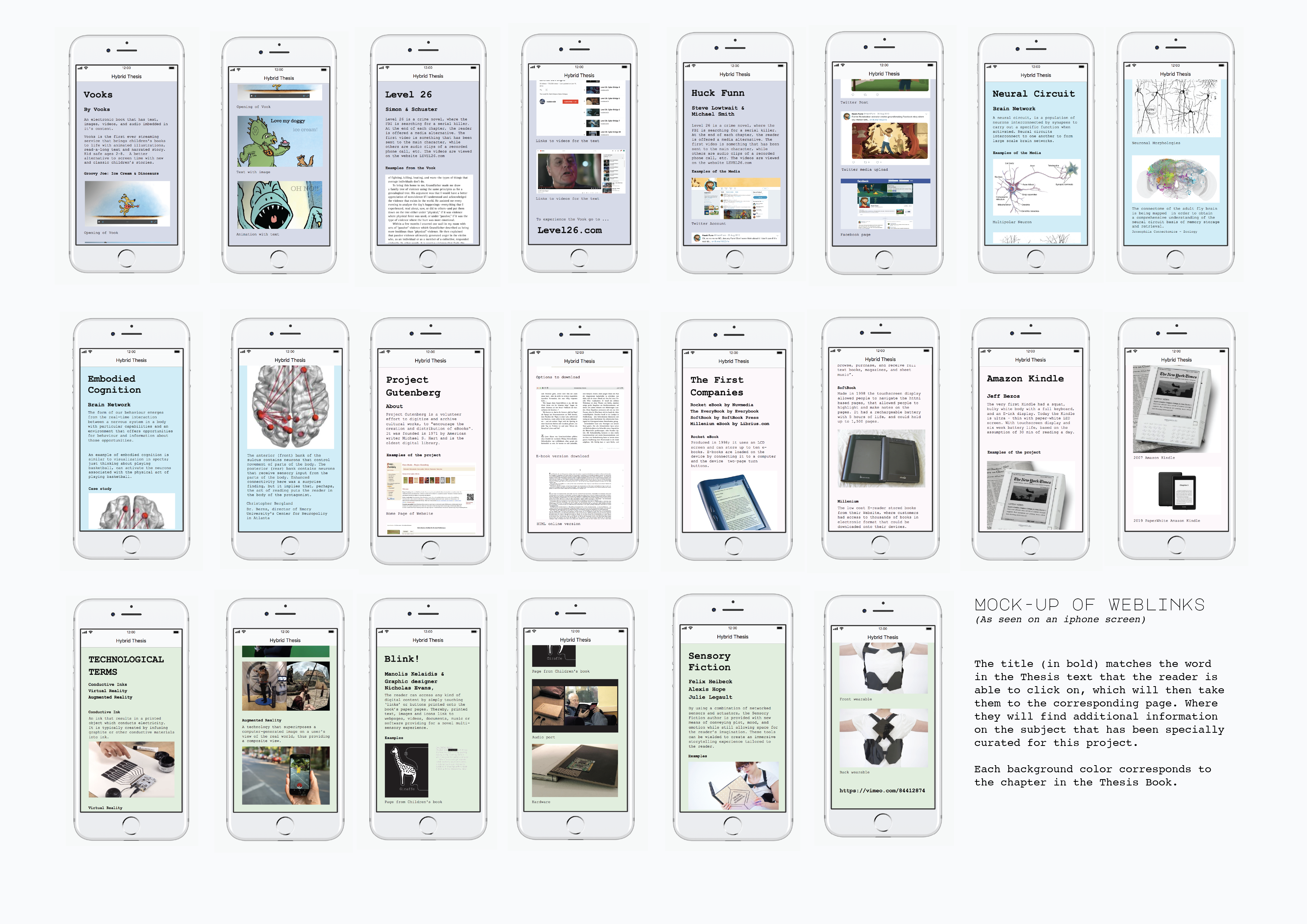
Design: The book itself was designed as a communication design object — typography, layout, illustration, and physical construction were all considered alongside the technology. The digital companion content was designed as iPhone-optimized web pages with curated resources spanning neuroscience, memory, technology, and cognitive development.
The result was a working prototype that a reader could hold in their hands — a physical book that, when touched, extended into a digital experience without ever requiring the reader to leave the page they were on. The analog and digital were not competing; they were collaborating.
Download BFA Thesis: Hybrid Books (PDF)
What This Demonstrates
This was a BFA thesis. I was 22. But the project reveals patterns that would define my entire career:
- Map the territory before designing in it. Before proposing a hybrid book, I spent months understanding the neuroscience of reading, the history of publishing technology, and the cognitive implications of the digital shift. This is the same approach I later applied to 26 government agency websites, 22 data connectors, and a 60-page UX Foundations document that redirected an entire product roadmap.
- Cross disciplines without asking permission. A communication design student building hardware prototypes with conductive ink, a Raspberry Pi, and Python code. This was not in the curriculum — it was what the problem required. The same instinct later led me to integrate Bastien & Scapin ergonomic criteria (a French framework) into American industry practice, and to bridge military officers with civilian administrators in co-design workshops.
- Ground conviction in evidence. The thesis does not argue that physical books are better than digital ones. It synthesizes neuroscience research to demonstrate measurably different cognitive outcomes — then proposes a design solution. This evidence-first approach became the foundation for my later Master's thesis on dark patterns, where I demonstrated the neurological mechanisms of manipulative design rather than simply asserting they are harmful.
Results
54 pages
Academic thesis with 15+ cited sources
4
User interview participants (ages 4-34)
3 x 3
Book types analyzed across 3 formats
Working
Physical prototype built and demonstrated
- 54-page formal academic thesis with 15+ cited sources spanning neuroscience, publishing history, and technology theory
- Novel analytical framework (Passive/Neutral/Active Expressive) for categorizing human-book interaction modalities
- Working physical prototype using conductive ink, Raspberry Pi, and Python
- User validation through interviews with participants aged 4 to 34
- The intellectual foundation — technology's impact on human cognition — that directly led to the Master's thesis on dark patterns two years later
The Thread Forward
This project was not an endpoint. It was the beginning of a question that keeps compounding:
- 2019 (BFA): How does the shift from analog to digital reading change the brain?
- 2020-2022 (Master's): How do dark patterns exploit the cognitive vulnerabilities that digital interfaces create?
- 2023 (Certification): What professional frameworks exist for designing technology that protects rather than exploits?
- 2023-2024 (J+Carbon): How do you embed responsible technology principles into commercial products?
Each stage built on the previous one. The BFA thesis asked the question. Everything since has been pursuing the answer.
Key Artifacts
Related Case Studies
See all projectsISEA Multimedia Digital Campus
Dark patterns, cognitive bias, and ethical design
Investigated how dark patterns exploit cognitive biases through neuroscience, behavioral economics, and regulatory analysis. Translated the research into LUX UX — a complete startup concept with market sizing ($183M-$356M), competitive benchmarking, and financial projections. 91% of surveyed users wanted dark pattern alerts.
Academic ResearchFrench Ministry of Defense
Redesigning the French Ministry of Defense web portal across 26 agencies
26 agencies, each with its own communication team and editorial process. 9 co-design workshops, 100+ participants from military and civilian organizations, 50+ site benchmarks, and reusable research infrastructure built to scale across the ministry.
Government UX